Emergency:
Maintenance:
Ductwork:
Indoor Air Quality:
Also:
Three Things We Do Differently
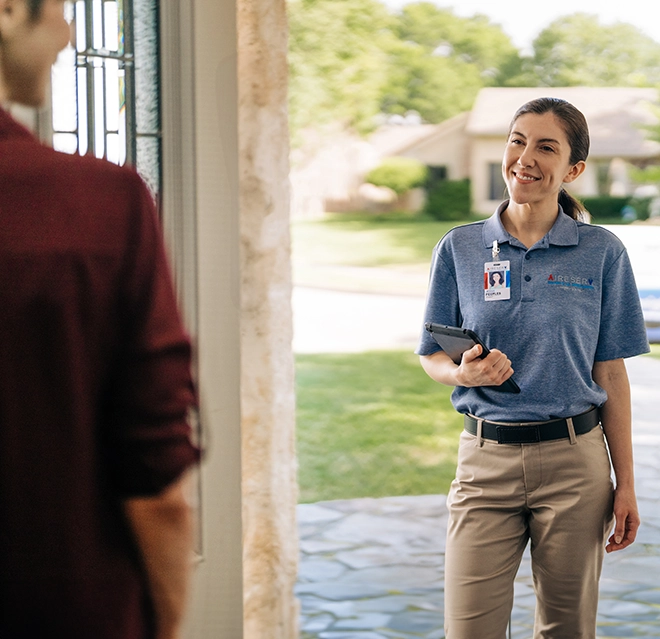
Every maintenance visit is documented. The same 22-step workflow runs on a technician's tablet in the same order every time, with photographs captured at fixed points from matched angles and readings recorded against nameplate specifications. Before we leave, the technician speaks a findings summary that becomes your written report. You get the same record we do, which in this industry is unusual.
We measure rather than assume. Refrigerant charge by superheat and subcooling, capacitors load tested against nameplate microfarads, static pressure across the duct system, indoor humidity on every comfort call. A diagnosis is not putting a hand in front of a vent and replacing the part that usually fails.
We will tell you when the answer is not a purchase. Duct sealing instead of a dehumidifier. A coil cleaning instead of a replacement. A configuration change instead of a repair. Nothing instead of anything, when your system is fine. That costs us some revenue, and it is why customers call us again.
What Actually Matters in This Climate
Humidity, not temperature. A house at 76 degrees and 50 percent humidity feels better than the same house at 72 and 70 percent. Most comfort complaints here are moisture complaints described in different words, and the fixes are correct sizing, duct sealing, and dedicated dehumidification rather than a colder thermostat.
Sizing, not tonnage matching. Cooling and dehumidifying are separate jobs, and moisture removal requires runtime. An oversized system reaches setpoint fast, shuts off, and never runs long enough to dry the air. Installing something larger to fix a humid house makes it worse, which is the most common mistake in this market.
Salt, and only near the water. Outdoor humidity is broadly similar across this whole territory, since everything here sits within about 25 miles of the Gulf. What differs on the coast is salt, which corrodes coils and electrical terminals and shortens equipment life in a way most warranties explicitly exclude. Inland homes in Pace, Milton, and Cantonment face the humidity without the corrosion.
Heating, on the few nights it matters. We get three to eight genuinely cold nights a year, which is exactly why heating fails here. Backup heat strips sit unused for eight or nine months and fail silently, then everyone discovers it in the same 48 hours. Test your heat in October.
Where We Serve
Pensacola, Pensacola Beach, Gulf Breeze, Navarre, Perdido Key, Beulah, Pace, Milton, and Cantonment, plus the surrounding communities across Escambia and Santa Rosa counties, including Ferry Pass, Brent, Ensley, Bellview, Myrtle Grove, Gonzalez, Tiger Point, Oriole Beach, Woodlawn Beach, Holley, East Milton, and Bagdad.
Written by the team at Aire Serv of Northwest Florida.
Technically reviewed by Justin B., NATE-certified and EPA 608 certified, 19 years in the trade.
Reviewed for accuracy by owner Justin Sonntag, a 26-year Gulf Coast resident.
Florida Certified Air Conditioning Contractor, license CAC1823566.
Last reviewed: September 2026
Questions about your system? Call or book online in about a minute.