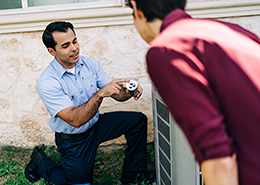
A thorough system assessment answers most questions without sampling anything.
Indoor relative humidity, measured rather than estimated. Static pressure across the system, which tells us whether your current filter is already restricting airflow. Evaporator coil condition and drain pan condition, which are the two most common sources of a musty odor complaint and both far cheaper to address than a whole-system cleaning.
Condensate drainage and whether the float safety switch actually functions. Duct condition and evidence of leakage, since a system pulling attic or crawl space air is importing whatever is in those spaces. Filter fit, and whether air is bypassing the filter rather than passing through it. Airflow at the registers. Ventilation and exhaust, including whether bathroom fans terminate outdoors or into an attic. And visible growth, staining, and moisture history.
You get findings in writing with photographs.
In most homes, it identifies the cause and the fix without a lab result, and it tells you something you can act on rather than a list of particles that are normal to find in a house.
What we are looking for throughout is the source rather than the symptom. Musty odor has a location. Uneven allergy symptoms have a pattern. Humidity that will not come down has a cause, and it is usually one of the items on that list rather than something airborne and mysterious.
That is also why the assessment frequently ends with a repair recommendation rather than an equipment quote.
When Testing Is Genuinely Worth It
There are real cases, and we will tell you when you are in one.
A documented moisture event: a roof leak, flood, or long-running condensate overflow where you need a record of conditions.
A health situation requiring documentation, such as a physician asking for information or a household member with a diagnosed condition where a professional wants data.
A real estate transaction where a buyer, seller, or insurer requires documentation rather than an opinion.
A dispute between landlord and tenant, an insurance claim, or a contractor disagreement where independent measurement carries weight.
Persistent symptoms after the obvious causes are ruled out, meaning humidity is controlled, the coil and pan are clean, the ducts are sound, and the problem continues.
One boundary worth stating plainly. Formal mold assessment and remediation are regulated activities in Florida performed under separate licensure. We assess HVAC systems and the moisture conditions that support growth, and where your situation calls for documented assessment, we will point you to an independent assessor rather than performing it ourselves. A company that both diagnoses mold and sells you the remediation has an obvious conflict.
When it is not worth it: as a first step before measuring humidity, to decide whether to buy equipment, or to prove there is no problem, since air sampling is a snapshot at one moment and absence of a finding does not establish an ongoing condition.
And if there is visible growth, the useful work is locating the moisture feeding it rather than quantifying spores in the air.